
Are Minnesota’s Best Lacrosse Towns Actually Hockey Towns?
P-Mac’s Rants | Down The Alley
I thought I had a pretty reasonable take.
Minnesota is a hockey state. A lot of our good lacrosse players also play hockey. A lot of our good lacrosse programs come from communities with strong hockey traditions.
So naturally, I threw it out there:
Are good hockey towns more likely to be good lacrosse towns?
Apparently, that was enough to get the comments going. 😂
Some people saw the connection. Others weren’t buying it. And because I’m always willing to calmly move on from an argument on the internet, I did the obvious thing.
I made four graphics and brought them to the podcast.
Let’s get into it.
First, Let’s Establish What We’re Arguing
I am not saying that winning a hockey state championship automatically qualifies you for the lacrosse state tournament.
I am asking whether the things that help build a strong hockey community can also help build a strong lacrosse community.
You’ve got athletes. Families who are invested in sports. Competitive expectations. Kids who understand spacing, transition, playing through contact, and making decisions while somebody is trying to take the puck—or ball—away from them.
That feels like a pretty decent starting point.
Now, before somebody submits the DTA Hockey Town Index to a university research department: these are our unofficial rankings. The scores are there to start a conversation. You can absolutely argue where your town belongs.
Honestly, I’m counting on it.
Exhibit A: The Champions
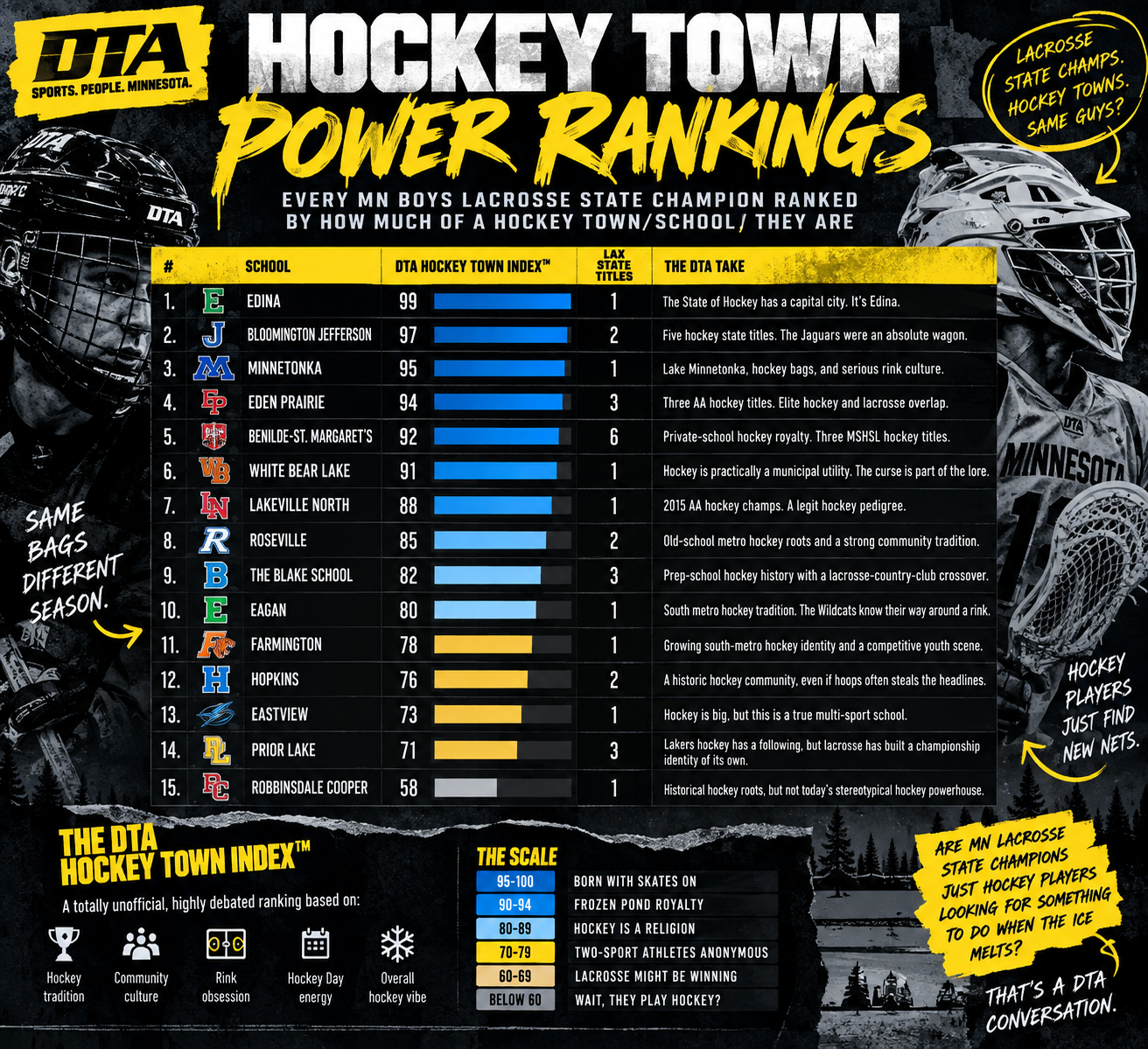
When you look at Minnesota lacrosse champions and start seeing names like Edina, Bloomington Jefferson, Minnetonka, Eden Prairie, and Benilde-St. Margaret’s, you can understand where my argument comes from.
Those names carry some hockey weight.
These are communities where people care about sports, expect competitive teams, and put resources into helping kids develop.
Does hockey deserve all the credit for their lacrosse success? Absolutely not. There are lacrosse coaches, youth programs, families, and players who built those results.
But I’m looking at the list and thinking, there’s enough overlap here to ask the question.
You don’t have to hand me the victory yet. Just acknowledge that I didn’t pull the entire idea out of thin air.
Exhibit B: The Title Drought Club

Then we looked at strong lacrosse programs that haven’t gotten over the championship hump.
Stillwater. Chanhassen. Other programs that can give you a very unpleasant afternoon on a lacrosse field.
Again, you see communities with hockey identities and competitive athletic cultures.
This is where I started feeling pretty good about myself.
Maybe the connection reaches beyond the teams holding trophies. Maybe having that athletic foundation gives a lacrosse program more to work with.
Then Ted offered a take that made the whole conversation more interesting.
Can Being Really Good at Hockey Actually Hurt Lacrosse?
Ted’s argument went something like this:
When hockey gets big enough in a community, it can start consuming the time, money, and attention that might otherwise go toward another sport.
Think about the kid trying to make a competitive varsity hockey roster.
There’s another camp. Another offseason team. Another training opportunity. Another reason to spend spring and summer focused on hockey.
At some point, that kid and their family have to make choices.
The same hockey culture that produces great athletes might also make it harder to get those athletes onto a lacrosse field.
That’s a good take.
Annoyingly good, considering I had already made the graphics.
A hockey town can give you a great potential player pool. Getting those kids to actually play—and stay involved—is a separate challenge.
Exhibit C: Hockey Royalty, Lacrosse Missing
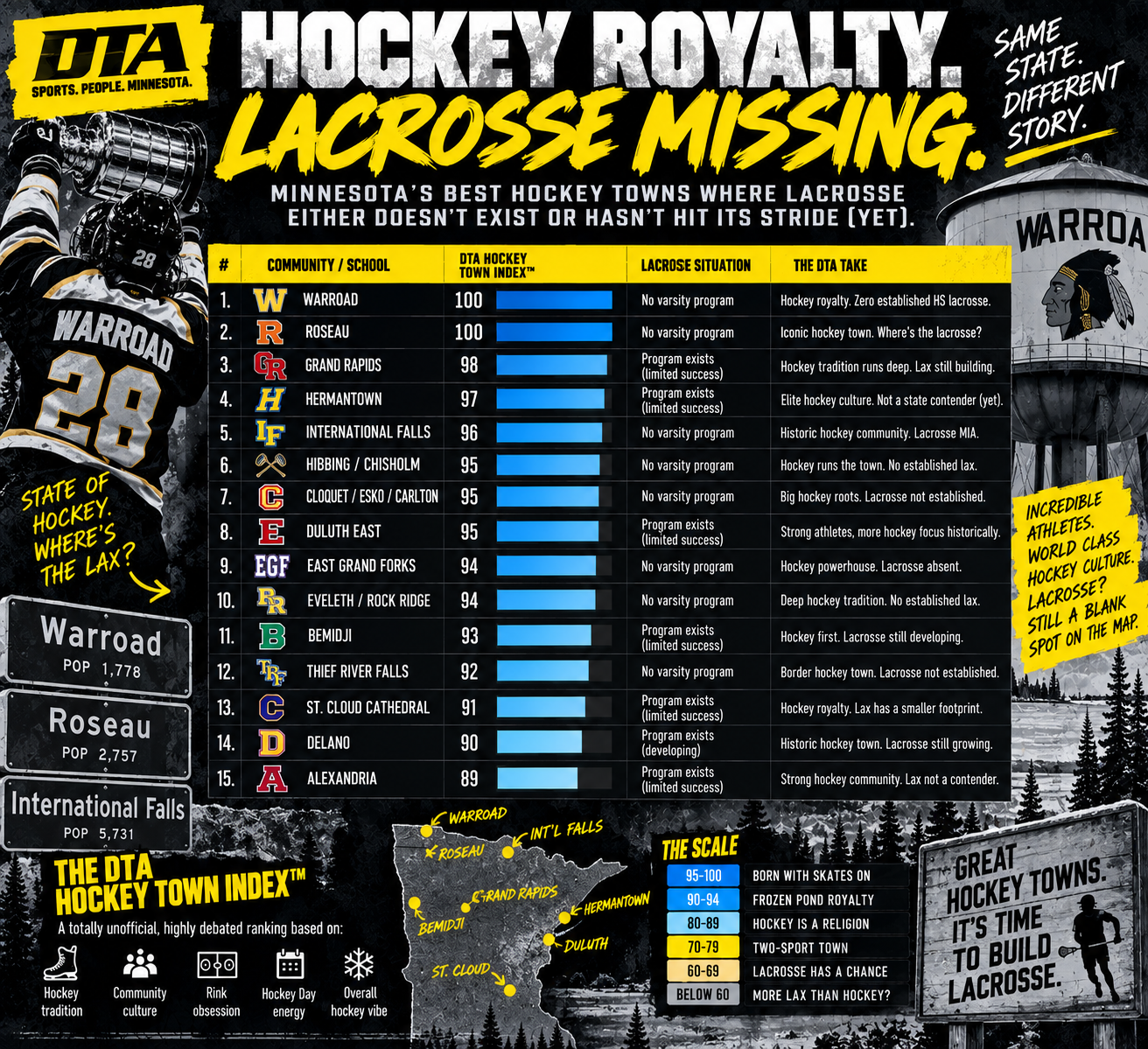
Now we get to the communities that make my original argument a little uncomfortable.
Warroad. Roseau. Other places where you can practically feel the hockey energy through the screen.
If hockey automatically produced lacrosse, we wouldn’t need this category.
But starting a program takes people. Somebody has to organize it, coach it, find field time, get equipment, and convince families to try something new.
And in a smaller community, how many kids are available?
Baseball isn’t disappearing. Track isn’t disappearing. Everybody is asking for some of the same athletes.
We floated a hypothetical Warroad–Roseau lacrosse co-op on the podcast, and I’ll admit it: that sounds pretty sweet.
Whether the numbers and logistics could work is a question for people who actually live there. North-country folks, I’m listening.
Exhibit D: The Ice Is Optional

As a Prior Lake guy, I had mixed emotions about this one.
We land at the top of our list of lacrosse programs whose identity doesn’t depend on being a hockey powerhouse.
On one hand: love seeing Prior Lake at the top of something.
On the other: hold on, we play hockey too. 😂
But this category matters. A community can build its own lacrosse tradition through good coaching, strong youth development, players buying in, and families coming back year after year.
Lacrosse can become the sport younger kids grow up wanting to play.
That doesn’t require permission from the hockey program.
So, What’s the Verdict?
I still think there’s a connection worth talking about.
A strong hockey community can give lacrosse a lot to work with. So can a strong football, basketball, or overall athletic culture. Ted made that point, and I think it’s fair.
But having athletes available and building a successful program are two different jobs.
Who’s leading it? What are they teaching? Can they get kids excited to come back? Is there a youth program feeding it?
Those questions matter a whole lot more than where your town lands on my very official-looking, very unofficial index.
My revised take: hockey can help create the opportunity. The lacrosse community still has to build something with it.
I’m still claiming partial credit.
Now defend your town: does hockey help your lacrosse program, compete with it, or have very little to do with it? And which spot on these graphics did we get wrong?
Watch the full conversation on Down The Alley and get in the comments.
🥍 Coaches: keep the conversation going inside The Coaches Box, our community for lacrosse coaches sharing ideas, talking film, and working through the challenges of building a program.
— P-Mac
